In short: marketing automation for a small business is five systems, not fifty tools. A monthly report agent, inbound lead routing, a brand-voiced content engine, a report-only ads watcher and an AI search citation log. Each one has a human decision built in, a number it is measured on, and a brake it can never release. This post shows all five, including the two I have not finished.
Key takeaways
· Marketing automation is a system that moves a stranger to a paying customer with less manual work, not a stack of subscriptions.
· Every system needs three things before it earns its keep: a human decision point, a measured number, and a hard stop.
· A system without a logged number is a demo. I log cost per run, minutes saved and what broke, every run.
· Two of my five systems are not finished. Saying so is part of the method.
· You can build one of these in a day if the strategy decision is made first.
What is marketing automation for a small business?
Marketing automation is the wiring between your marketing tools so that routine work happens without you, and the judgement calls still come to you. For a small business that means your ads, website forms, CRM, email platform and content tools connected into one flow, with a person deciding only the things a person should decide.
That definition matters because most owners I meet have the tools already. They have HubSpot or Zoho, Mailchimp or Klaviyo, a website form, a Google Ads account and a Canva login. What they do not have is the wiring, or any way of knowing whether the wiring is working.
A career guide published last week put it plainly: somebody has to wire the tools into one machine. The guide was written for people who want a job doing that. I have spent 25 years deciding what the machine should do. This year I started building it.
Why I stopped selling strategy on paper
For most of my career the deliverable was a strategy document. A good one. The client would nod, pay, and then the plan would sit in a drawer because nobody had the hours to run it.
That was not going to keep working. So in 2026 I changed what MacInnis Marketing hands over. The strategy still comes first. Then I build the system that runs it, in the client's own tools, and I log whether it works.
Here are the five systems, including the two that are not done.
System 1: the monthly report agent
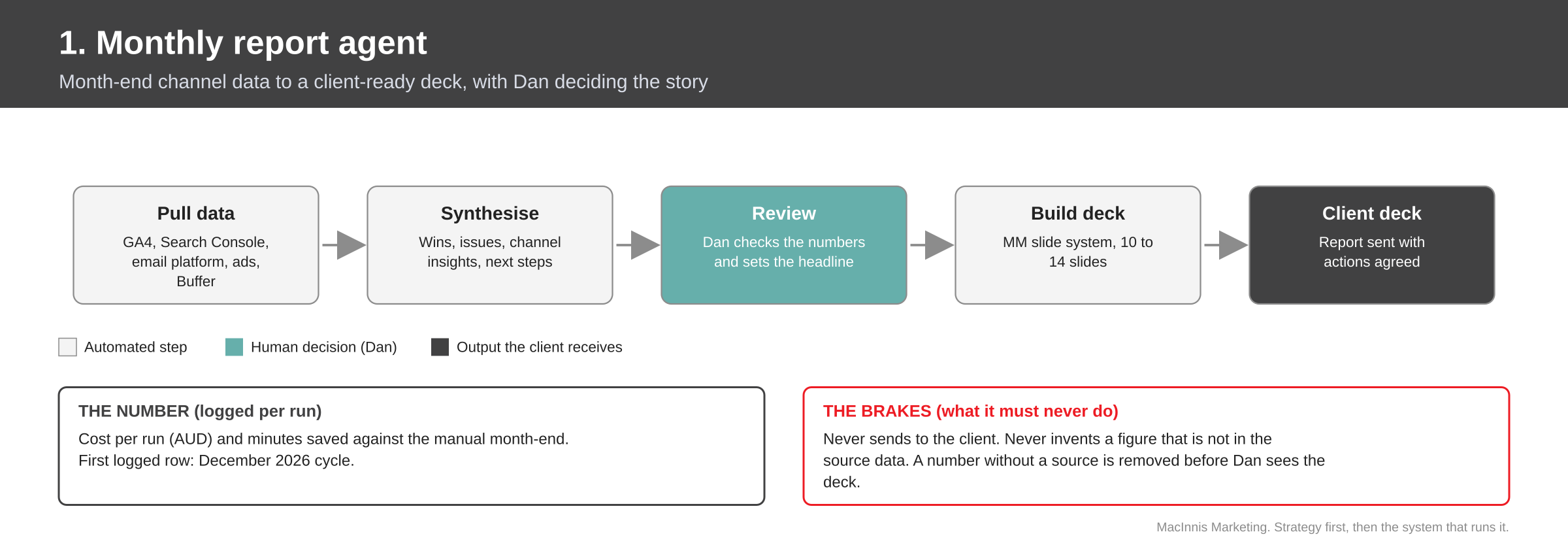
What it does: pulls the month's data from Google Analytics, Search Console, the email platform, the ad account and Buffer. Writes the wins, issues, channel insights and next steps. Builds the client deck in my slide system.
Where the human sits: I check the numbers and set the headline before the deck is built. The agent does not decide what the month meant. I do.
The number: cost per run and minutes saved against doing the month-end by hand. The first logged row is the December 2026 cycle. I will publish it when it exists, not before.
The brake: it never sends to the client, and a figure with no source is removed before I see the deck.
System 2: inbound lead routing
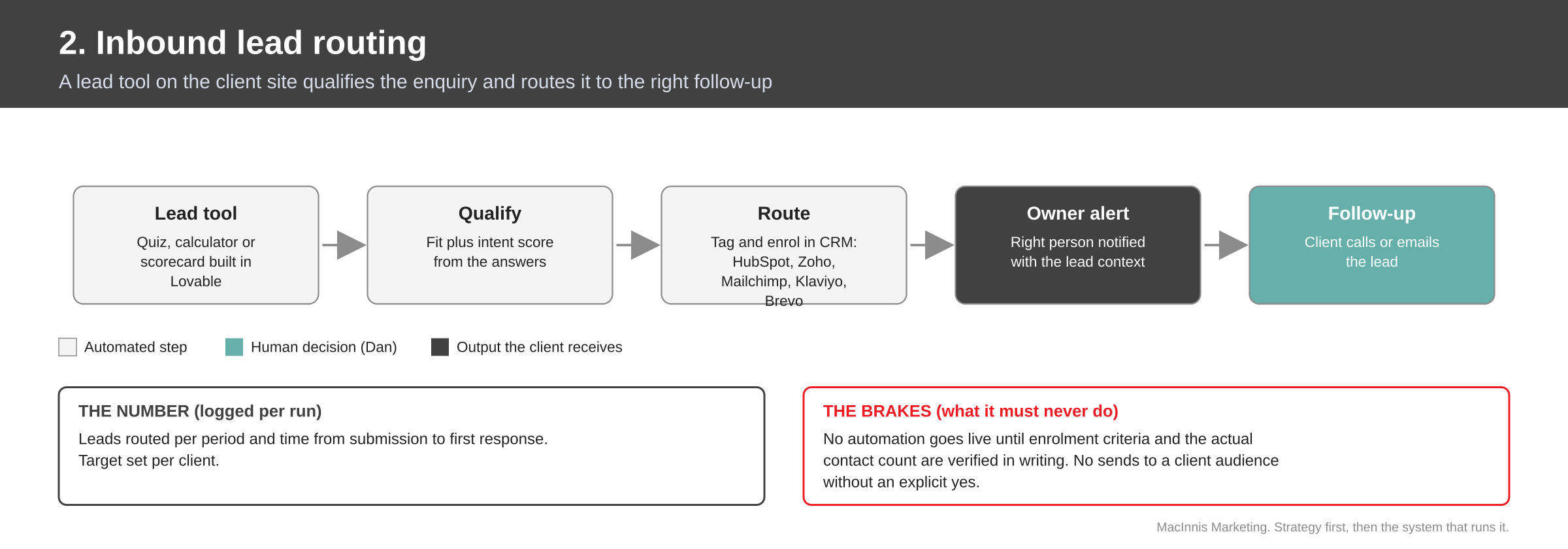
What it does: a quiz, calculator or scorecard on the client's site qualifies the enquiry, scores fit and intent, tags the contact in the CRM and alerts the right person with the context they need to call.
Where the human sits: the follow-up call. Always.
The number: leads routed per period and time from submission to first response.
The brake: nothing goes live until I have verified, in writing, exactly which contacts the automation will touch and how many there are. One wrong enrolment rule can email an entire database. That is not a risk worth taking to save ten minutes.
System 3: the brand-voiced content engine
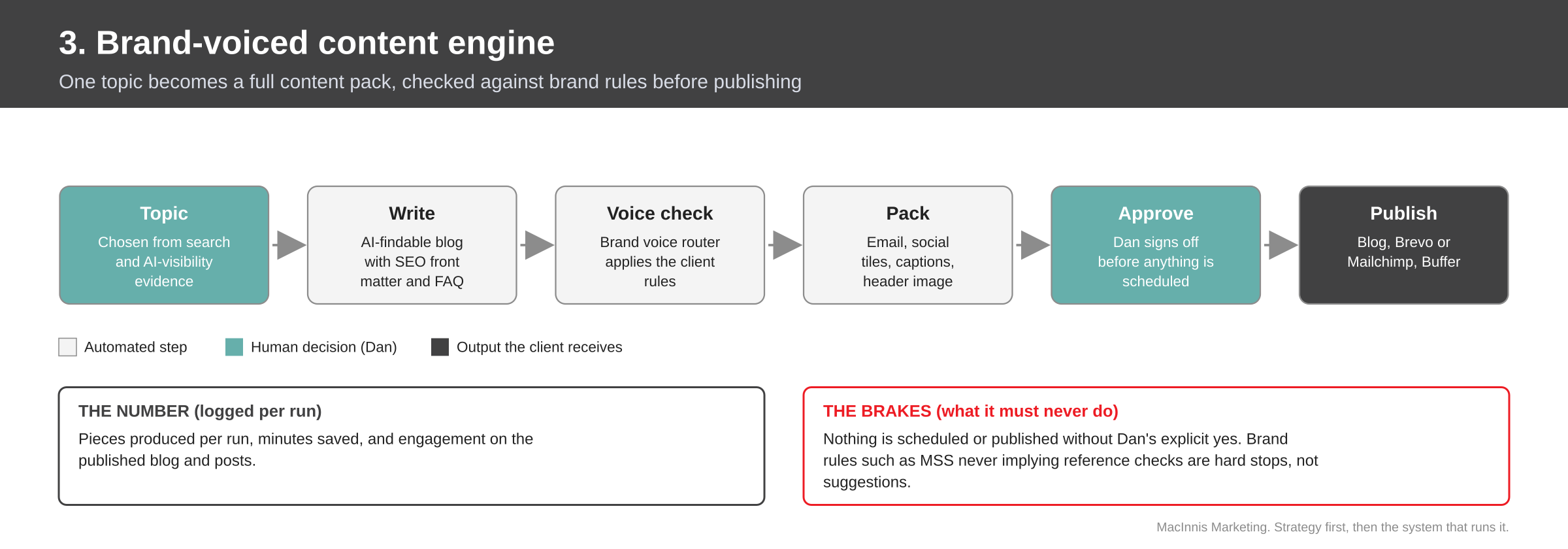
What it does: turns one topic into a blog with its SEO front matter and FAQ, an email, social tiles and captions, and a header image. Every piece is checked against the client's brand rules before I see it.
Where the human sits: topic choice at the start, sign-off at the end. Both are mine.
The number: pieces produced per run, minutes saved, and engagement on what gets published.
The brake: nothing is scheduled without my explicit yes. Brand rules are hard stops, not suggestions. One client's rule is that we never imply they do reference checks. The engine cannot override that, and neither can a rushed Friday afternoon.
System 4: the report-only ads watcher (not built)
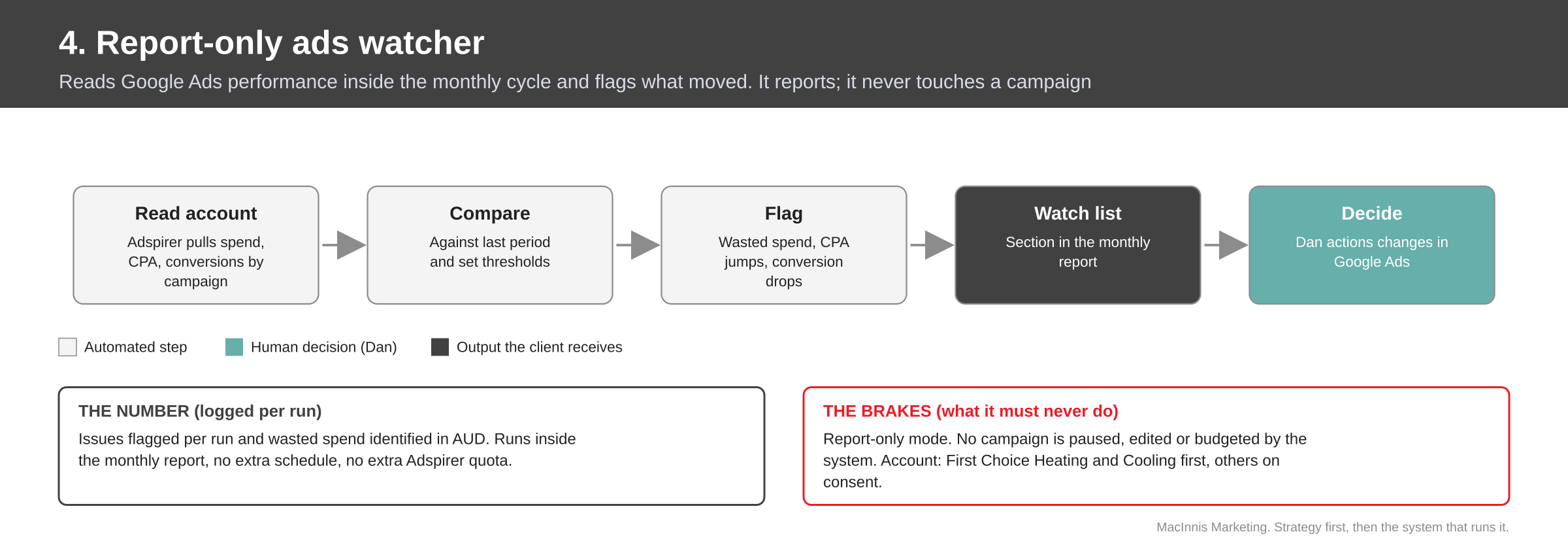
What it will do: read Google Ads performance inside the monthly cycle and flag spend, cost per acquisition and conversion changes outside set thresholds.
Where the human sits: every change to the account. The watcher reports. It does not touch a campaign.
Why it is not built: my ad data connector has a monthly call limit, and a weekly watcher would exhaust it in the first run. So it goes inside the monthly report instead of running on its own schedule. That is a design constraint, and I would rather tell you about it than pretend the system is live.
System 5: the AI search citation log (partly built)
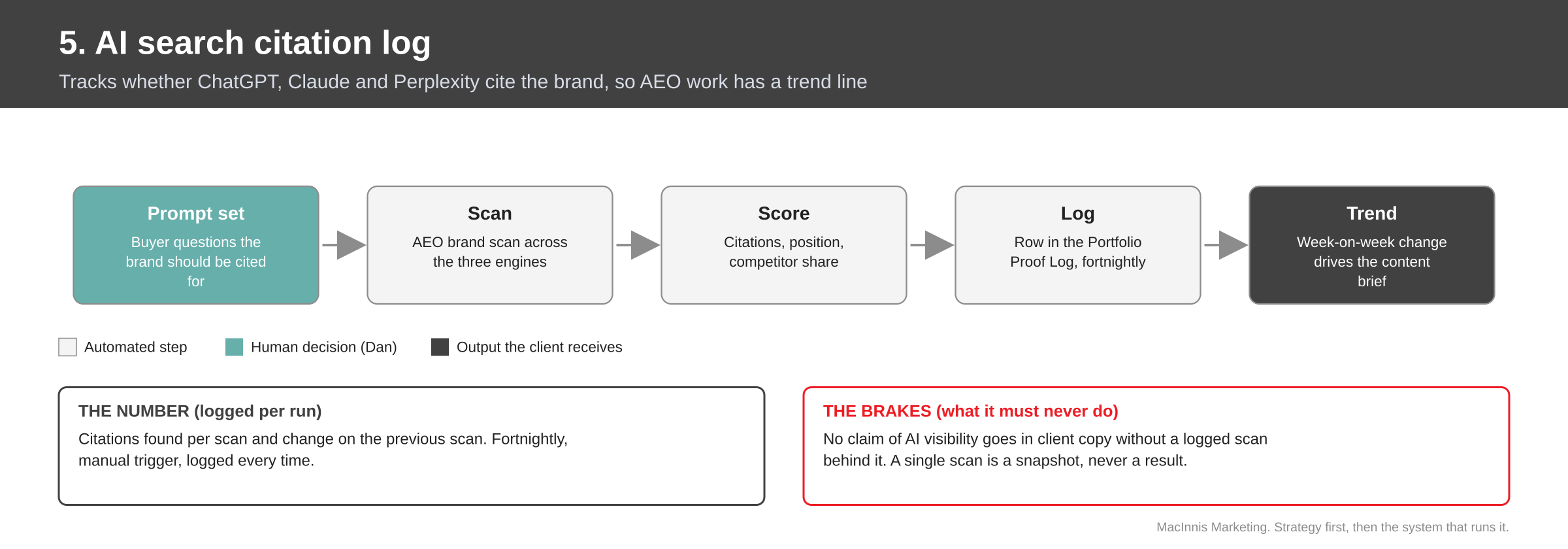
What it does: scans whether ChatGPT, Claude and Perplexity cite a brand for the buyer questions it should be cited for, and logs the result so there is a trend line, not a one-off score.
Where the human sits: writing the prompt set. The questions a buyer would ask are a strategy decision.
The number: citations found per scan and the change on the previous scan.
The brake: no claim of AI visibility goes in client copy without a logged scan behind it. A single scan is a snapshot.
A note on what AI visibility work is not. Google's own guidance says there are no extra requirements to appear in AI Overviews or AI Mode, no special schema, and no need to rewrite or chunk content for AI. Anyone selling you an "AI schema" package is selling you formatting. What earns a citation is a specific, sourced answer the current top results do not have.
The three things every system needs
Look at the five diagrams and the pattern is the same each time.
A human decision point. The teal box. The system does the repetitive part. The owner, or I, decide the part that needs judgement: the headline, the follow-up call, the topic, the ad change, the buyer questions.
A number logged per run. Not an estimate. Cost per run, minutes saved, what the output was, what broke, who used it. If I cannot log it, I do not call it a system.
A brake. The red box. The one thing it must never do, written down before it runs. Never send. Never change a campaign. Never publish without a yes.
The meta-skill here is not the wiring. It is knowing which box each step belongs in. That is a strategy decision, and it is the part I bring.
What this costs you if you ignore it
Nothing dramatic. You keep paying for tools you half use. Your leads keep sitting in a form inbox until someone remembers to look. Your monthly report keeps being whatever you had time to pull together. And you keep hearing about AI from people who have not built anything with it.
Build one of these with me
I run a Build AI Workshop for small business owners. One day, in your tools, we build one of the five systems above and switch it on with its brake in place. You leave with a working system, the number it is measured on, and the log to prove it.
Start with the one that costs you the most hours. For most owners that is the monthly report or the lead follow-up.
Book a Build AI Workshop or read how we approach marketing strategy first.
Frequently asked questions
What is marketing automation for a small business?
It is the wiring between your existing tools so routine marketing work happens without you, while judgement calls still come to a person. Ads, forms, CRM, email and content connected into one flow, with a human deciding the things a human should decide.
Do I need new software to automate my marketing?
Usually not. Most small businesses already own the tools. What is missing is the connection between them, a measured number per run, and a rule for what the automation must never do.
How do I know if marketing automation is working?
Log every run: what it cost, how many minutes it saved, what it produced and what broke. If you cannot log it, you cannot know. A system with no logged number is a demo.
Is AI marketing automation safe for a small business?
It is safe when it has a human decision point and a hard stop. The risks come from automations that send, publish or change campaigns without a person approving. Build the brake before the engine.
What is a Build AI Workshop?
A one-day working session where MacInnis Marketing builds one marketing system with you, in your own tools, and switches it on with its measurement and its brake in place. You leave with something running, not a plan.