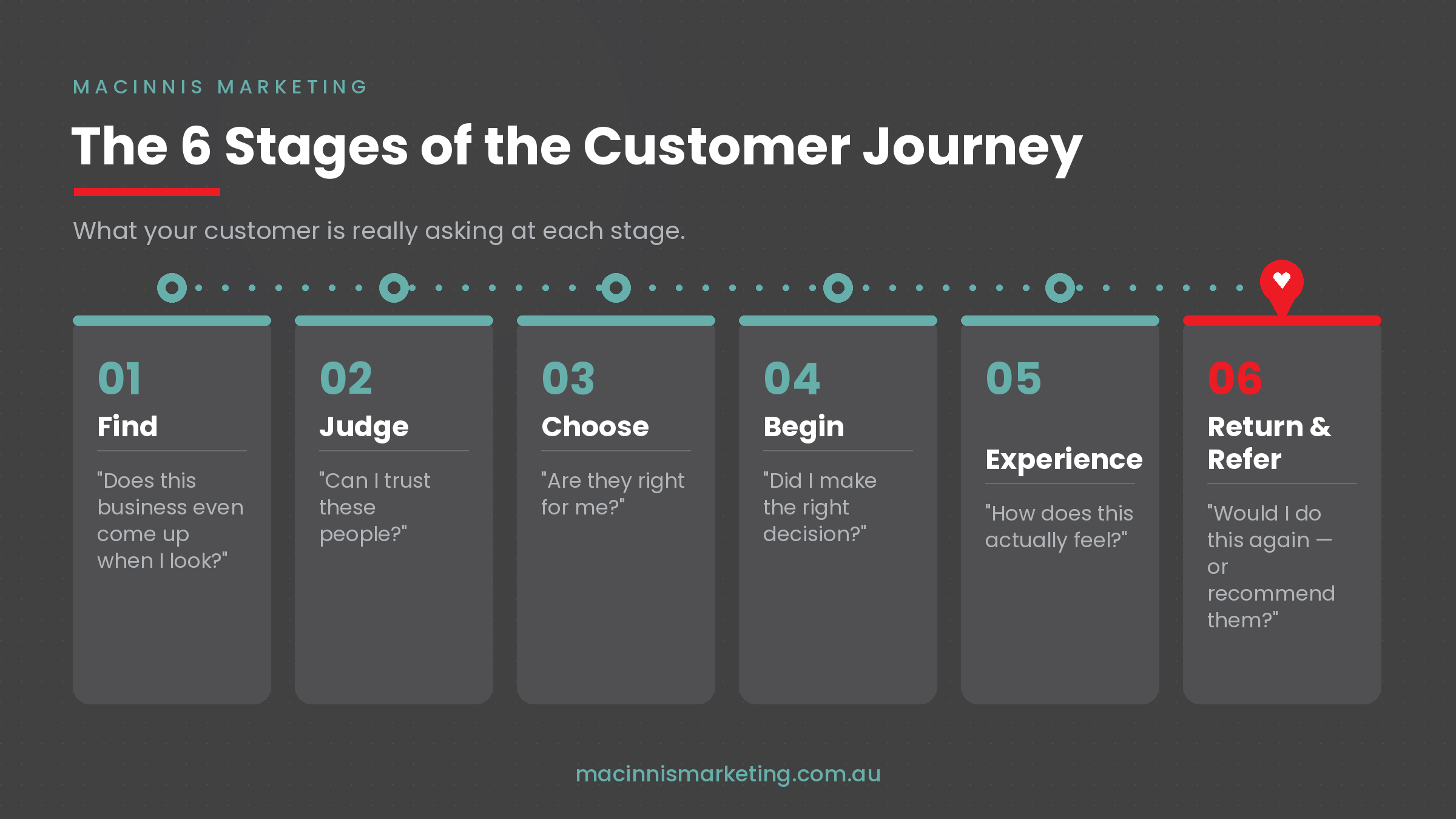
Your customers are already on a journey with your business. The only question is whether you've designed it, or left it to chance.
Every customer, in every business, moves through the same six stages: from the moment they first find you to the moment they decide whether to come back and tell someone. When you can name those stages, you can see your business the way your customer does. And once you can see it, you can fix the parts that are quietly costing you.
Here are the six stages, what the customer is really thinking at each, and where small businesses most often lose them.
Stage 1: Find
This is discovery. The customer becomes aware you exist: through a search, a referral, a social post, or an ad.
The question in their head: does this business even come up when I go looking?
Where it leaks: you're invisible where this particular customer actually looks. You rely entirely on word-of-mouth with no way to be found by anyone new. Or your social presence exists but sounds like a brochure, so people scroll past.
The fix starts with a question you can ask this week: how did your last five customers actually find you? The answer usually surprises people, and tells you where to put your effort.
Stage 2: Judge
Now they've found you, and within seconds they're deciding whether you're worth their time. They glance at your website, skim your reviews, notice how long you take to reply.
The question: can I trust these people?
Where it leaks: a weak or dated first impression. No visible proof: no reviews, no testimonials, no case studies, at the exact moment doubt creeps in. A slow or clumsy response to that first enquiry, which tells them everything they need to know about what working with you will feel like.
Trust at this stage is built with two things: a fast, human response, and proof that's visible right when they're wavering.
Stage 3: Choose
They're interested. Now they decide whether you're the right fit, and whether to take the next step.
The question: are they right for me, and what exactly do I do next?
Where it leaks: a confusing offer that makes them work to understand what you actually do. Friction in the enquiry process, too many fields, too many steps, no clear path. Or simply no obvious next step, so a warm prospect cools off while they figure out what you wanted them to do.
Good businesses make the next step obvious and low-risk. One clear invitation beats five clever ones.
Stage 4: Begin
They've said yes. And almost immediately, a quieter question sets in: did I make the right decision?
This is onboarding, and it's the most neglected stage in most small businesses. The marketing effort went into winning the customer; the moment they commit, the attention often disappears, right when they're most anxious for reassurance.
Where it leaks: silence after the yes. A confusing or non-existent onboarding process. No one setting expectations about what happens next and when.
This stage is pure opportunity. A deliberate first 48 hours, a warm welcome, clear expectations, one message that says "here's what happens now", turns buyer's remorse into buyer's confidence. It costs almost nothing and very few of your competitors do it.
Stage 5: Experience
Now the actual work happens. This is the longest stage and the one customers judge most.
The question: how does this actually feel, day to day?
Where it leaks: communication that goes quiet mid-delivery. No proactive updates, so the customer is left wondering. Problems handled defensively instead of openly. The work might be excellent, but if the experience of receiving it feels like hard work, the customer remembers the friction, not the quality.
What good looks like here isn't complicated: proactive updates, and a customer who feels heard rather than processed. Often it's a single check-in they weren't expecting.
Stage 6: Return & Refer
The work is done. Now the customer decides two things: whether to come back, and whether to tell anyone about you.
The question: would I do this again, or recommend them?
Where it leaks: no follow-up after the work finishes. No reason given to return. And, most commonly, never actually asking for the referral, leaving the single most powerful form of marketing entirely to chance.
This stage feeds straight back into Stage 1. A well-looked-after customer becomes how the next customer finds you. The journey is a loop, not a line, and most businesses cut it off right before the part that pays them back.
What to do with this
Read back through the six stages and be honest about which ones you've actually designed and which you've left to chance. Most businesses find their first three stages are reasonably considered and their last three are an afterthought, which is exactly backwards, because Begin, Experience and Return & Refer are where loyalty and referrals are made.
Pick the one stage that made you wince as you read it. That's where to start.
And if you want to map all six properly, with someone whose job is to spot the leaks you're too close to see, that's what a Customer Journey Package is for. We map your journey together and leave you with a clear plan to fix the stages that are costing you.
Explore the Customer Journey Packages with MacInnis Marketing.